
Building a Hotel Tea Menu: A Guide for F&B Managers
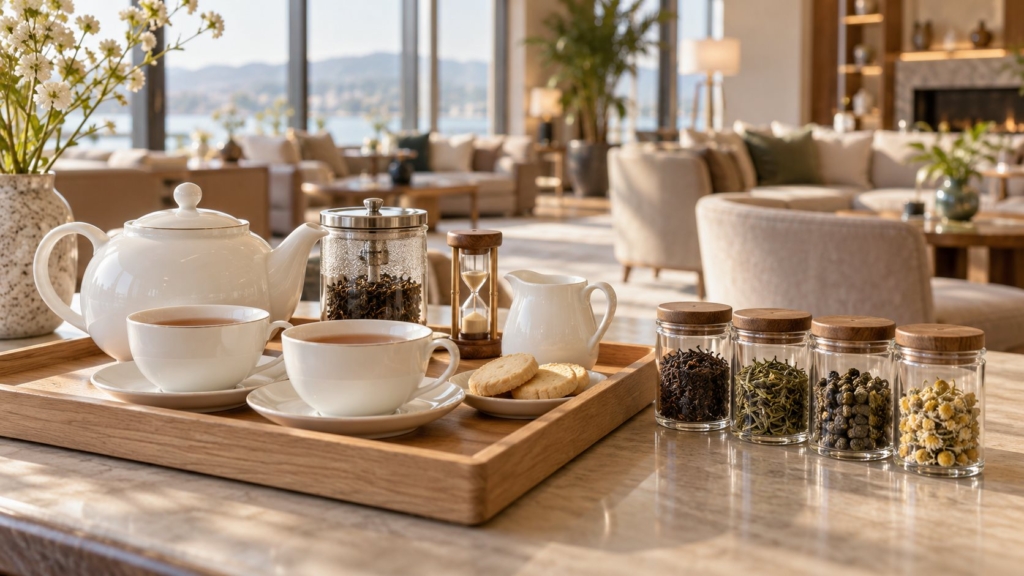
Picture a typical moment at breakfast. A guest asks which tea goes best with eggs and toast. The server lists five names from the menu card, then pauses. They know what’s on offer, but not what any of it tastes like. The guest picks the first name they recognise, and the pot arrives over-steeped and bitter.
Nothing went badly wrong, but the moment was lost. Most tea problems in hotels look like this: a reasonable selection, uneven brewing and staff who haven’t been given the words to describe it. A good hotel tea menu fixes all three. This guide walks through how to choose, price, serve and review one.
Start with your guests and service occasions
Before choosing a single tea, list where tea is actually served in your property and who drinks it.
- Business hotels: speed and reliability, a sharp breakfast peak, and meeting-room tea that holds up in a flask.
- Resorts: slower days and tea served poolside or in the afternoon, so presentation and variety matter more.
- Boutique properties: a smaller, more distinctive selection that reflects the hotel’s character.
- Hotels with afternoon tea: teas that pair with sweet and savoury dishes and justify a premium price.
Then map each occasion: breakfast, restaurant service, afternoon tea, meetings, banquets, room service and in-room amenities. Each has different needs for speed, format and price point.
Base guest preferences on your own data, such as breakfast orders, room-service requests and feedback, rather than assumptions about where guests come from. Common patterns include a strong cup with milk at breakfast, lighter teas later in the day and steady evening demand for caffeine-free options.
Build a focused core selection
Six to eight teas is a sensible starting point for most properties. That’s editorial guidance, not an industry rule, but a short menu is easier to brew well, explain and keep fresh than a long list of slow-moving tins.
Each tea on the menu should have a clear job:
| Role | What it does | Example from JANAT’s Professional Series |
|---|---|---|
| Robust breakfast black tea | Strong enough for milk; the breakfast workhorse | English Breakfast, or Ceylon (blended for milk tea) |
| Aromatic black tea | A familiar, fragrant choice for any time of day | Earl Grey (bergamot oil, recipe used since 1923) |
| Green tea | Lighter and fresher, good with meals | Japanese Sencha (organic, from Kagoshima) |
| Lighter or distinctive premium tea | Gives the menu depth and a reason to trade up | Darjeeling, or Oolong High Mountain |
| Caffeine-free herbal infusion | Covers evening and caffeine-conscious guests | Camomile, Peppermint or Rooibos Orange |
| Optional seasonal or signature tea | Adds interest without bloating the core | A seasonal or French Oak blend |
Tea vs herbal infusion. “Tea” means leaves from the Camellia sinensis plant: black, green, oolong and white teas, all of which contain caffeine. Herbal infusions such as camomile, peppermint or rooibos come from other plants. They are usually caffeine-free, but confirm the ingredient list before you describe one that way.
Choose loose leaf, tea bags or sachets by service setting
Format should follow the service, not the other way round. Many hotels use more than one.
| Format | Suitable service settings | Operational advantages | Trade-offs | Equipment considerations |
|---|---|---|---|---|
| Loose leaf | Afternoon tea, fine-dining restaurants, lounges | Presentation, flexible portions, room for leaves to expand | Needs weighing and timing; more cleanup | Scales or measured scoops, teapots with infusers or strainers, timers |
| Tea bags | Breakfast buffets, room service, meetings, banquets | Fast, consistent portions, simple training | Less control over strength; less theatre at the table | Hot water dispensers or urns, bag rests or saucers |
| Individually wrapped sachets | In-room trays, meeting rooms, grab-and-go | Hygienic and protected from air and moisture; easy stock counts | Extra packaging; higher unit cost is common | Display boxes, dry and cool storage |
Format alone doesn’t decide quality or environmental impact. A well-brewed tea bag beats a fine loose leaf left steeping for ten minutes.
JANAT, for example, sells its Garden Series herbal teas in 25-bag boxes, and its Provence Four Flavour Assortment in a 40-bag box with each bag sealed in aluminium. Ask any supplier which formats are available for the teas you want.
Write menu descriptions that help guests choose
A good description answers four questions in one line: what it tastes like, how strong it is, what it’s made from, and how to take it. Skip poetry. “Malty”, “citrus-led”, “delicate” and “roasted” give a guest more to go on than “exquisite”.
Illustrative examples only, not JANAT product copy:
- Breakfast blend: Full-bodied, malty black tea. Strong enough to take milk.
- Earl Grey: Black tea scented with bergamot. Citrus-led and fragrant; good plain or with a splash of milk.
- Japanese Sencha: Green tea with a fresh, grassy taste. Light and clean, best without milk.
- Darjeeling: Delicate black tea with a fruity, muscatel note. Best served plain.
- High Mountain Oolong: Roasted, rounded and full-bodied. Serve without milk.
- Camomile: Caffeine-free infusion of camomile flowers. Soft and honeyed; a gentle evening choice.
Only mark something “caffeine-free” when its ingredients justify it. Any blend containing black, green or oolong tea contains caffeine, whatever the flavouring.
Calculate cost per serving and set prices sensibly
Two formulas do most of the work:
Servings per pack = usable pack weight ÷ grams per serving
Tea cost per serving = pack cost ÷ servings per pack
Worked example (hypothetical figures in US dollars, not JANAT pricing)
| Step | Figure |
|---|---|
| Pack cost | $40.00 for a 500 g loose-leaf pack |
| Usable weight | 490 g (allowing 10 g for dust, spillage and tasting) |
| Tea per serving | 4 g per pot |
| Servings per pack | 490 ÷ 4 = 122.5, so 122 full servings |
| Tea cost per serving | $40.00 ÷ 122 = $0.33 |
| With a 10% waste allowance | $0.33 × 1.10 = $0.36 |
That $0.36 is only the leaf. Milk, sugar, lemon, the accompanying biscuit, labour, energy, breakage and dishwashing all add to the real cost. Build those into a full cost per serving before you set a price.
Margin and markup are not the same. Suppose the tea plus milk, sugar and lemon costs $0.76, and the menu price is $6.00 before tax:
- Gross margin = (price − cost) ÷ price = $5.24 ÷ $6.00 = 87.3%
- Markup = (price − cost) ÷ cost = $5.24 ÷ $0.76 = 689%
The two numbers describe the same sale, so be clear which one your finance team uses. There’s no universal ideal margin. Price against your other hot drinks, your outlet’s positioning and what guests are used to paying locally.
Make brewing consistent across shifts
The same tea can taste completely different at 7 a.m. and 9 p.m. if each shift brews it their own way. Consistency comes from a few fixed decisions, written down.
- Portion: fix grams or bags per pot size. Measured scoops are faster than scales during a rush.
- Water: filtered water tastes cleaner; very hard water makes tea dull and flat.
- Temperature: near boiling for black tea and most herbal infusions, cooler for green tea. One urn setting won’t suit every tea.
- Steeping time: this is where most cups go wrong. Keep a timer at the station.
- Teapot capacity: portion for what each pot actually holds, not a nominal “two cups”.
- Removing the leaves: take out the infuser or bags on time, or the second cup turns bitter.
Always start from each product’s own brewing instructions. Where none are given, general ranges such as 3–4 minutes for black tea or 2–3 minutes for green tea are only starting points. Taste, adjust, then write down what works.
Put the result on a preparation card at each station: tea name, portion, water temperature, steeping time, milk or lemon, and the line staff should say to the guest. Laminate it and keep it where the tea is made.
Train staff to recommend tea naturally
Staff don’t need to be tea experts. They need two or three words per tea and a simple question to ask. Taste sessions before launch help more than any script.
A guest who wants a strong breakfast tea
Guest: I need something strong this morning. Server: Our English Breakfast is the boldest we have. It’s full and malty and takes milk well. Would you like milk with it?
A guest who prefers a delicate cup
Guest: Nothing too heavy. Something lighter? Server: The Darjeeling is lighter, with a slightly fruity note. It’s best without milk. If you’d like something greener and fresher, the Japanese Sencha is lovely too.
A guest looking for a caffeine-free evening drink
Guest: Anything without caffeine? It’s late. Server: The camomile is caffeine-free, soft and lightly floral. We also have peppermint if you’d like something more refreshing.
The pattern is simple: listen, offer one clear recommendation, give one reason, then a single alternative. No pressure and no health promises.
Pair tea with food and add seasonal interest
A few pairings printed on the menu, or known by staff, make choosing easier:
- Full breakfast: a robust, malty black tea with milk stands up to eggs, bacon and buttered toast.
- Continental breakfast and croissants: Earl Grey’s citrus lifts butter and pastry.
- Lighter dishes, fish or rice: a green tea such as Sencha keeps things clean.
- Scones, fruit tarts and afternoon-tea pastries: Darjeeling or a fruit-scented black tea.
- Chocolate or caramel desserts: a roasted oolong, or a caramel-flavoured tea.
For more ideas, see our tea and food pairing guide.
Keep seasonal changes small. Rotate one slot, not the whole menu. Swap a single signature tea each season, such as a spiced winter blend or a fruity summer iced tea, and buy it in modest quantities. Guests get something new to try, and you avoid tins of a festive blend lingering into spring.
Evaluate suppliers beyond the price per pack
The cheapest pack can end up costing more if quality varies, deliveries slip or staff can’t get answers. Use this checklist when you compare suppliers:
- Samples: Can you taste the teas brewed with your own water and equipment?
- Consistency: How is flavour kept consistent between batches?
- Ingredients and allergens: Is full information available for every product, including flavourings?
- Formats: Which teas come loose, bagged or in sachets, and in what pack sizes?
- Shelf life: How long unopened and once opened, and what storage is recommended?
- Lead times: How long from order to delivery at your location?
- Minimum orders: Is there a minimum order quantity or value?
- Availability: Are core teas available year-round, and how are seasonal or discontinued teas handled?
- Brewing guidance: Are brewing instructions provided for each tea, and is there any training support?
Record the answers in writing, so you can compare suppliers like for like.
Pilot the menu and review performance
Before printing a new menu across every outlet, consider trialling it in one or two outlets for around six to eight weeks. That’s long enough to cover busy and quiet periods, and short enough to correct quickly.
Track a handful of measures:
- Servings sold per tea and per outlet
- Sales mix: which teas carry the menu and which barely move
- Cost per serving against your calculation
- Waste: expired stock, discarded pots, broken bags
- Stockouts: how often a tea ran out mid-service
- Preparation issues: complaints about strength, bitterness or temperature
- Guest feedback: comments to staff, reviews and survey responses
Then act on what you find. A tea that rarely sells and goes stale should be cut or moved to a smaller format. Repeated complaints about strength usually point to brewing, not the tea, so revisit the preparation card. If one tea keeps running out, review the par level before adding anything new.
Before you launch: a quick checklist
- Service occasions mapped, with a format chosen for each
- Six to eight teas, each with a clear role, including at least one verified caffeine-free option
- Plain-language menu descriptions written and checked against ingredients
- Full cost per serving calculated and prices set
- Preparation cards in place at every station
- Staff tasting session held
- Supplier questions answered in writing
- Pilot measures and review date agreed
Exploring JANAT for your property
JANAT has been blending tea since 1872, and its Professional Series covers the core roles described above, from English Breakfast and Earl Grey to Japanese Sencha, Darjeeling and caffeine-free herbal infusions. You can read more about JANAT as a tea supplier for hotels and restaurants.
If you’re planning a new tea menu, contact the JANAT team to discuss which teas suit your service, along with formats and availability for your location.
Frequently asked questions
How many teas should a hotel menu offer?
Six to eight is a practical starting point for most properties: a breakfast black tea, an aromatic black tea, a green tea, a premium tea, a caffeine-free infusion and an optional seasonal choice. A shorter menu is easier to brew consistently and keep fresh.
Should hotels choose loose-leaf tea or tea bags?
Choose by service setting. Loose leaf suits afternoon tea and restaurants, where presentation matters. Tea bags and sachets suit breakfast buffets, room service, meetings and in-room trays, where speed and portion control matter. Many hotels use both.
How do you calculate tea cost per serving?
Divide the usable pack weight by the grams per serving to get servings per pack. Then divide the pack cost by servings per pack. Add a waste allowance, then include milk, sugar, accompaniments and other costs before setting a price.
What should an F&B manager ask a tea supplier?
Ask about samples, batch consistency, ingredient and allergen information, pack formats, shelf life, lead times, minimum orders, year-round availability and brewing guidance. Get the answers in writing.
How can hotels maintain consistent tea service across shifts?
Fix the portion, water temperature and steeping time for each tea, starting from the product’s own instructions. Put them on a preparation card at each station, use timers, remove leaves after brewing and run regular staff tastings.
Tea for your business.
Looking for tea for your hotel, café, or shop? Ask about JANAT collections and wholesale enquiries.